



Guru’s strength is surfacing verified, documented knowledge in context: a browser extension on top of your CRM/helpdesk, with verification workflows that keep content trustworthy.
The best Guru alternative for business owner-operators who need follow-through
Guru keeps your documented knowledge findable across the tools your team uses. readywhen captures the commitments that aren’t documented, and drives them to done.
Quick answer
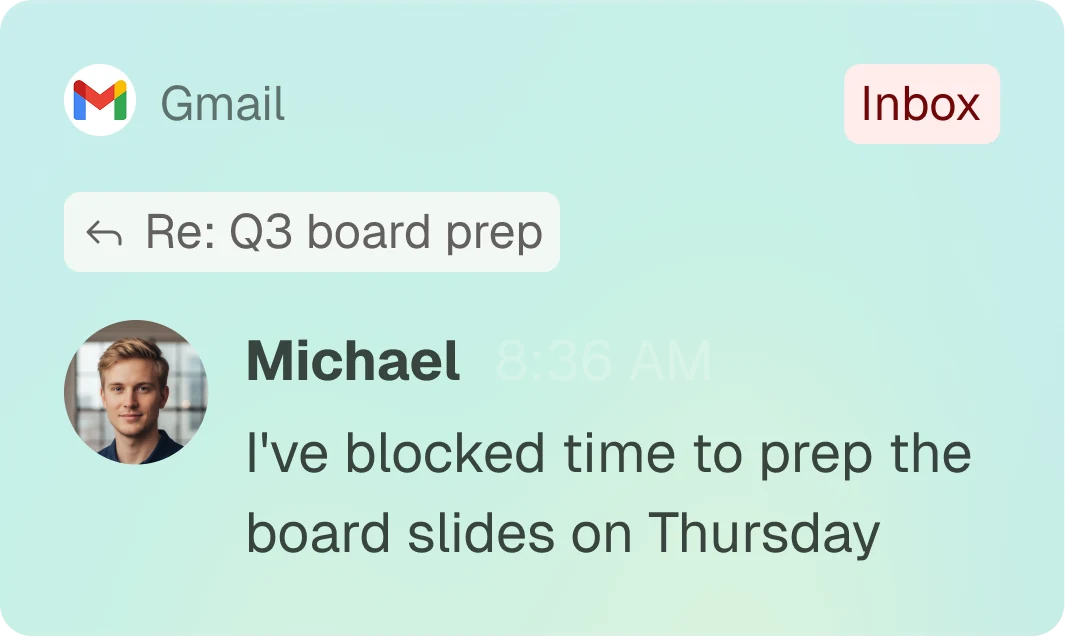
Guru keeps your documented knowledge findable across the tools your team uses. readywhen captures the commitments that aren’t documented (the ones made in a call, a Slack thread, or an email) and drives them to done. Different problems; they coexist cleanly.
Who this page is for
Teams using Guru for knowledge management, asking whether it also handles cross-functional follow-through.
What makes readywhen different
The core difference

readywhen’s strength is catching the undocumented commitment and executing it: no curation, no knowledge base to maintain.
Guru surfaces what’s written down and verified. The commitments business owner-operators lose were never written down. That’s the gap readywhen fills (labelled readywhen analysis).
Side by side
Feature comparison
Capability
At a glance
Primary job
Knowledge type
Surfacing model
Maintenance
Trigger
Buyer

Catches commitments across every tool
Commitments made anywhere (often undocumented)
Captures, owns, chases, escalates
No knowledge-base curation required
Automatic, without you asking
Business owner-operators and their teams
Guru
Verified knowledge management + contextual search
Documented, verified content
Browser extension on top of daily tools
Ongoing write/tag/verify upkeep
You search it
Knowledge/enablement/support leads
Where Guru excels
Guru is a capable, well-rated tool for documented knowledge: strong contextual search and in-workflow surfacing. readywhen doesn’t try to be a knowledge base.
“Guru is strong for documented, verified knowledge. readywhen handles the commitments that were never documented: a different job.”
Where Guru and readywhen fit together
Guru works on what’s written down and kept current; readywhen works on what isn’t (the commitment made in a call or a Slack thread) and drives it to done, no curation required (labelled readywhen analysis).
“If it wasn’t written down and verified, a knowledge base can’t surface it. readywhen captures it from the conversation itself.”
Where teams run both
Guru for documented knowledge; readywhen for the undocumented commitment a knowledge base can’t see.
“Guru is where our verified answers live. readywhen catches the things we agreed but never wrote down. They don’t overlap.”
FAQ
Is readywhen a Guru alternative?
No. Different problems (documented knowledge vs. commitment follow-through).
Does readywhen need a knowledge base?
No: it works from live commitments, not curated content.
Should I choose Guru or readywhen?
It isn’t either/or. Guru does its job; readywhen does the execution job on top. Most teams run both: keep Guru and connect Guru so the things agreed around that work actually get done.